
Quick answer. Mangal dosh, or Manglik status, arises when Mars occupies particular houses in a birth chart. It is frequently over-diagnosed. This consultation establishes whether the dosha is genuinely present, whether any of the classical cancellations apply, and what — if anything — needs to be done about it.
Why the Manglik label is so often wrong
Mangal dosh is said to occur when Mars sits in the first, second, fourth, seventh, eighth or twelfth house from the ascendant. Traditionally it is associated with friction in marriage. That is the whole of the basic rule, and it is why the label attaches to a very large number of charts — by some counts a third or more of them.
The classical literature, however, surrounds that rule with a long list of cancellations. Mars in its own sign or exalted, particular aspects from Jupiter, the same dosha appearing in both partners' charts, the Moon's placement, age — each can nullify or substantially reduce the effect. Software and hurried readings tend to apply the rule and skip the cancellations entirely.
The result is families calling off matches over a dosha that, properly assessed, either was not present or was already cancelled. Master Vijay Ram sees this often enough that it is worth stating plainly: a great many people carrying the Manglik label do not, on a careful reading, have anything requiring action.
Where the dosha is genuinely present and uncancelled, traditional remedies exist and are prescribed — specific mantras, fasting on Tuesdays, charity associated with Mars, and in some cases a Kumbh Vivah. These are explained fully, including what they are understood to do and what they cannot do.
A clear, caring path
How the assessment is made
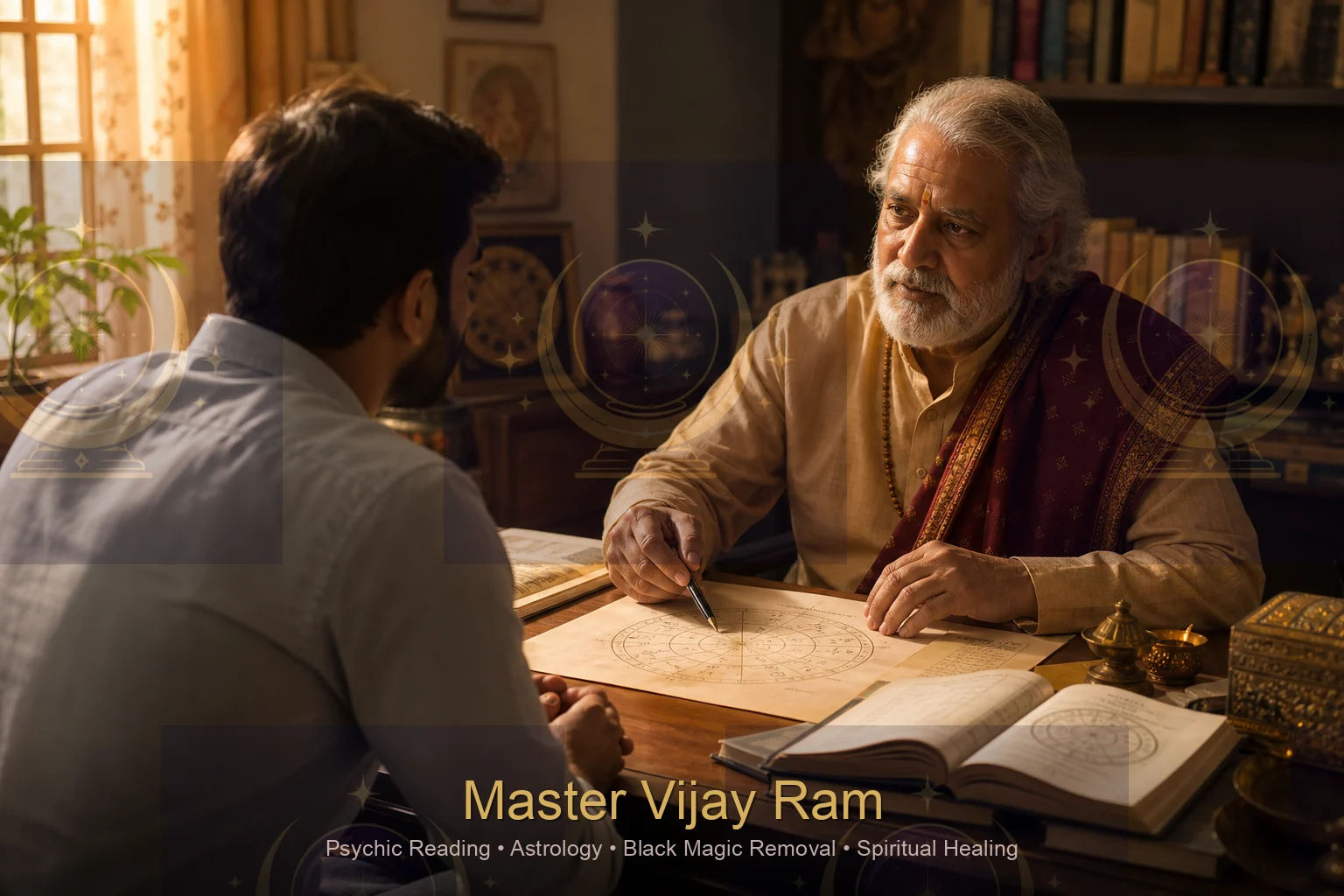
The assessment first establishes whether Mars genuinely qualifies as causing the dosha, then applies the classical cancellations in order, and prescribes only what is actually warranted. Mangal dosh is frequently over-diagnosed, and often the honest finding is that it does not stand.
Establish whether Mars qualifies
Your chart is checked from the ascendant, the Moon and Venus, since the dosha is properly assessed from more than one reference point and a single-point reading is where most errors begin.
Apply the classical cancellations
Every recognised cancellation is worked through — sign placement, Jupiter's aspect, mutual dosha, age and others — to determine whether anything actually remains.
Prescribe only what is warranted
Where a genuine uncancelled dosha remains, specific remedies are given. Where it does not, you are told that clearly and no remedy is sold to you.
Do any of these sound familiar?
When to have this checked
Particularly worth doing before a family makes a decision on it.
- A proposal has been refused because you were called Manglik
- An online report flagged Mangal dosh and gave no explanation
- Two reports have disagreed about whether you have it
- You have been quoted a large sum for a Manglik remedy
- A Kumbh Vivah has been suggested and you want a second opinion
- Both partners have been told they are Manglik
Your questions, answered
Manglik & Mangal Dosh — your questions answered
In classical practice, mutual Mangal dosh is one of the recognised cancellations and is often treated as neutralising the effect. Whether it fully applies depends on the specific placements in both charts, which is exactly what the consultation examines.
Only in a small number of cases, and far less often than it is recommended. Where the dosha is strong and uncancelled it remains a traditional option. Where it is not, Master Vijay Ram will say so — this is one of the remedies most often sold unnecessarily.
No. It is traditionally associated with friction and with the temperament Mars brings, not with a doomed marriage. Countless people with the placement have long settled marriages, which is worth remembering when a report presents it as a verdict.
Yes, and it is worth checking. Manglik status is over-diagnosed, and the classical cancellations are frequently skipped. A second assessment costs far less than a decision made on a wrong one.
English, Hindi or Punjabi, whichever you prefer. Families routinely move between them during a session, and that is entirely normal.